Writing a CV with no experience can feel overwhelming, especially if you’re applying for your first role or changing careers completely.
Whether you’re a school leaver or a career changer, the challenge is often the same: how do you prove your value before you’ve built formal experience?
Most entry-level candidates in the UK are in the same position, and recruiters know this. So, they are looking for potential, direction, and evidence that you can do the job.
A well-structured first-job CV that UK employers can scan quickly can absolutely secure interviews, even if you’ve never worked before.
This blog will walk you through a practical, step-by-step structure you can follow to build a CV with no experience that still gives you a realistic chance of getting shortlisted.
What should a CV with no experience include?
A strong CV with no experience should include clear personal details, a professional summary, relevant skills, education, certifications, additional experience, and references.
1. Personal Details
Even if you aren’t creating your first job CV, UK employers will always expect your personal details to be clear, professional, and easy to find at the top of your CV.
This section should include your full name, email address, and mobile number, along with your area and postal code (for example, “Manchester, M1”). There is no need to include your full home address for safety and privacy reasons.
You should also include a LinkedIn profile link, even if it’s basic, as many recruiters will check this before shortlisting candidates.
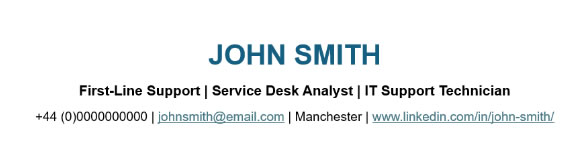
A useful addition (especially for entry-level candidates) is to include two to three job titles you are targeting. For example, if you are looking to break into the IT industry, you might list IT Support Technician, Service Desk Analyst, and First-Line Support. This immediately signals to recruiters what roles you are applying for and helps align your CV with their search criteria, despite not having held those job titles as formal work experience.
How to approach this yourself
This section is about making a strong, professional first impression.
Use an email address that is simple and appropriate (ideally your name) and make sure your voicemail message sounds professional in case an employer tries to contact you.
Choose job titles based on the entry-level roles you are applying for most often, or the titles that appear most frequently on job boards, and by the end of it, the top of your CV should look something like this:
Choose job titles based on the entry-level roles you are applying for most often, or the titles that appear most frequently on job boards, and by the end of it, the top of your CV should look something like this:
2. Professional Summary
When you don’t have experience, your professional summary is one of the most important sections of your CV.
A simple and effective structure you can use is:
“A motivated and detail-oriented professional with a strong interest in [industry or role]. Known for being [2–3 soft skills, such as proactive, reliable, or collaborative], with developing skills in [relevant hard or technical skills]. Recently completed training in [course or subject area], demonstrating a solid understanding of [key knowledge areas]. Currently seeking an entry-level opportunity within [industry], to apply my skills, continue learning, and contribute to a professional team.”
This removes the need for prior experience while still highlighting your strengths, training, and direction.
For example:

How to approach this yourself when writing a CV with no experience
If you’re not sure what to write, break it down into four simple questions:
- What kind of role or industry am I aiming for?
- What personal qualities describe how I work?
- What skills or knowledge have I already started developing?
- What are my career goals right now?
Another helpful tip is to look at job descriptions for roles you’re interested in and identify the qualities and skills that appear most often. You can then reflect those in your summary (as long as they genuinely apply to you).
Your professional summary should feel specific and intentional. Avoid vague phrases like “hardworking individual” on their own – try to combine them with context that shows direction and commitment to your chosen career.
3. Skills
When writing a CV with no experience, your skills section becomes one of the strongest ways to demonstrate your potential.
Instead of listing skills randomly, organising your skills into hard, soft, and technical categories makes your CV easier for recruiters to scan and tailor to different roles.
Hard skills are practical, teachable abilities that can be learned through education or training. These are usually task-based and directly related to how work gets done, for example, writing reports, using spreadsheets, managing tasks, or understanding project processes.
Technical skills are a specific type of hard skill. These are specific tools, systems, or specialist knowledge used in a particular field, such as Windows OS, macOS, or Microsoft Project.
Soft skills, on the other hand, are how you work rather than what you do. These include behaviours and personal qualities such as communication, teamwork, adaptability, and problem-solving.
If you’re unsure where a skill fits, a simple way to think about it is:
- If it’s something you can learn and measure, it’s likely a hard or technical skill, and
- If it’s about how you interact or behave, it’s a soft skill.
Structuring your skills into a table makes it easier to cover all three areas and tailor your CV for different roles.
For example:
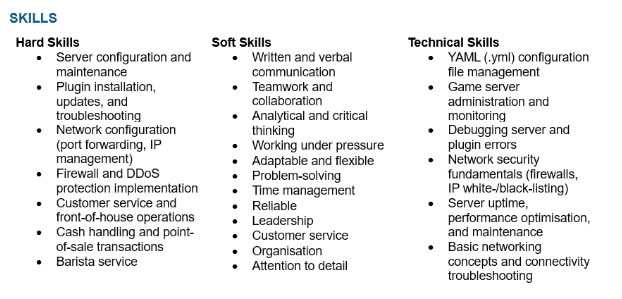
This format helps recruiters quickly scan your capabilities and see how you might fit into a role.
How to identify your own skills when writing a CV with no experience
If you feel like you don’t have any skills, that’s rarely the case.
Think about where you already use skills in daily life, school, or training: assignments show time management and written communication, group work shows teamwork, helping others solve problems shows communication and initiative, and regular use of digital tools can count as a basic technical skill.
You don’t need a job title to have skills – you just need to recognise where you’ve already used them.
4. Education and Training
For a first-job CV, UK recruiters tend to place more weight on education and training than they would on experienced candidates.
This section should include your school, college, or university education, along with any relevant subjects. If you have completed any structured training programmes, online courses, or career-focused learning, these should also be included here.
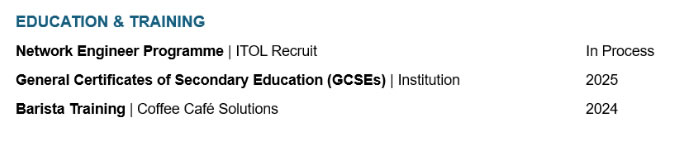
How to approach this yourself when writing a CV with no experience
If your education feels “not relevant” or “not impressive enough”, take a step back and look at it differently.
Identify anything you have completed that shows learning and progression, such as school subjects, college or university study, short online courses, or structured training. If you’ve completed recent training, position it as a key strength.
Employers are much more likely to shortlist candidates who have already taken steps to build relevant knowledge, even if they don’t yet have formal experience.
5. Certifications
Certifications should be listed separately from education and should only include official, recognised qualifications, such as certifications from awarding bodies including APM, CompTIA, BCS, APMG International, PeopleCert, CMI, CIPD, or others, depending on your chosen field.
Certifications show commitment, direction, and a willingness to invest in your development.

How to approach this yourself when writing a CV with no experience
If you don’t have any certifications yet, this is the quickest way to strengthen your CV. Unlike experience (which takes time to build), certifications allow you to demonstrate job-specific knowledge in a fairly short timeframe.
That’s why so many candidates choose ITOL Recruit: we help identify suitable career paths and provide structured programmes with recognised certifications.
6. Projects, Volunteering, or Additional Experience
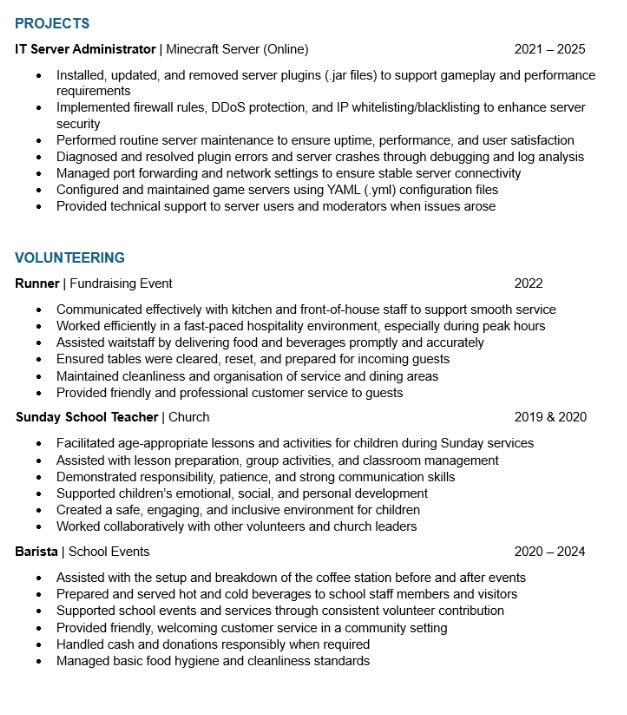
This is one of the most valuable sections when writing a CV with no experience because even if you don’t have formal employment history, you can still illustrate experience through practical, real-world activities, for instance, projects completed during training, volunteering, informal work, shadowing, freelance tasks, or extracurricular activities.
For school leavers and complete career changers, this section is what tends to bridge the gap between potential and proof.
How to approach this yourself when writing a CV with no experience
If you feel like you have nothing to include here, you may be thinking only in terms of formal jobs.
Try to reframe this as, “Where have I contributed or applied a skill?”
This could include things like course projects, self-study, helping friends or family, volunteering, extracurricular activities, or small freelance tasks. The key is what the experience demonstrates, not how “official” it is.
Here, focus on:
- What you did,
- What skills you used, and
- What the outcome was.
For example, instead of simply writing “Completed an IT course project”, you should say:
“Completed practical IT troubleshooting exercises, diagnosing and resolving common hardware and software issues, developing strong problem-solving and analytical skills.”
Even “small” examples can show initiative and practical ability.
7. Hobbies and Interests
For a CV with no experience, an intentional “hobbies and interests” section can reinforce qualities like curiosity, discipline, teamwork, or problem-solving.
For example, if you are applying for an IT role, an interest in technology, gaming, or troubleshooting devices can support your application.

How to approach this yourself when writing a CV with no experience
When thinking about what to include, focus on hobbies that demonstrate relevant qualities or a genuine interest in your chosen field.
Ask yourself:
- Does this hobby show a useful skill or behaviour?
- Does it support the type of role I’m applying for?
For example, helping others with tasks (such as organising events) shows initiative and communication, or learning new skills online shows curiosity and self-motivation.
Do not include hobbies that don’t add value or create a negative impression. The goal of this section is to reinforce your suitability, not distract from it.
You don’t need a long list; two to four well-chosen interests are enough.
8. Languages
A languages section can strengthen your CV, even if you only speak a second language at a basic level.
Language skills demonstrate a variety of useful qualities, including communication ability, cultural awareness, adaptability, and willingness to learn – and these are all highly valued by employers, especially in diverse or customer-facing environments.
How to approach this yourself
If you speak more than one language (even at a basic or conversational level), it’s worth including.
Be honest about your proficiency and keep it simple.
For example:
- English – Fluent
- French – Conversational
- Yoruba – Basic

If you only speak one language, it’s perfectly acceptable to leave this section out – include this section only when it adds value.
9. References
At the end of your CV, simply state: “References available upon request.”
You should never include full reference details directly on your CV – this protects both your privacy and the privacy of your referees.

How to approach this yourself
If you have no experience, you can still provide strong and credible references. Some suitable options include a teacher, tutor, course instructor, or someone else that you have worked with in a volunteering, community, or structured learning environment.
Avoid using family members as referees (this is generally seen as unprofessional by employers).
Always ask permission before listing someone as a reference, so that they are prepared to provide a relevant recommendation if contacted.
Ready to Go from No Experience to Hired?
A strong CV is only one part of getting hired – but it’s often the first step.
If you want to put everything in this guide into practice, download our No Experience CV Template, designed to help school leavers and career changers structure their CV clearly, professionally, and in a way recruiters can scan quickly.