Changing careers doesn’t mean starting from scratch – but your CV needs to reflect that.
One of the biggest challenges career changers face is not a lack of experience. It’s how that experience is presented. Most candidates already have the skills required for roles in Project Management, Business Analysis, Data Analysis, IT, or HR. The issue is that those skills are often hidden behind job titles and responsibilities that don’t immediately translate.
At ITOL Recruit, we’ve helped over 5,000 candidates transition into new careers, with most securing roles within 1 to 3 months after completing their training. The difference is not their background – it’s how their CV positions that background.
In this guide, we’ll show you exactly how to transform your CV using real career change CV examples (in the UK), so you can clearly demonstrate your value to employers.
The Structure of a Career Change CV (Why It’s Different)
Before we look at specific sections, it’s important to understand one key shift.
A traditional CV focuses on experience first, usually structured something like:
- Professional summary
- Skills
- Work Experience
- Education and Training
- Certifications
- References
However, a career change CV prioritises relevance.
That’s why the structure we recommend places skills, education, and certifications before work experience – so that employers immediately see why you are a strong fit for the role, even if your background is different.
1. Professional Summary: Position Yourself for the Role You Want
Your professional summary is the first thing a recruiter reads. It should immediately position you as someone capable of doing the job – not someone hoping to transition into it.
Let’s look at how the professional summary changes in practice.
Here is a Project Management candidate’s original professional summary:
“Motivated and detail-oriented entry-level Project Manager with strong organisational, communication, and creative thinking skills. Experienced in primary education involving; planning, assessing and reviewing, working as a team across year groups in an ever-changing, fast-paced environment to make a difference to children’s education. Passionate to learn how to deliver successful outcomes, working with cross-functional teams and using my skills to positively contribute and lead projects.”
This kind of summary is common. It’s positive, but it positions the candidate as learning, aspiring, and not yet fully ready.
This is what the candidate’s professional summary looked like after tweaking for maximum impact:
“Proactive, adaptable, and detail-oriented Project Manager with strong organisational, communication, and strategic thinking skills. Experienced in planning, assessing, and reviewing work to ensure objectives have been achieved, as well as working as an effective member of cross-functional teams in fast-paced environments. Certified in the APM Project Fundamentals Qualification (PFQ), PRINCE2 Foundation & Practitioner, and AgilePM Foundation and Practitioner, bringing a passion to deliver successful project outcomes. Currently seeking the opportunity to positively contribute to a creative, progressive organisation that values continuous improvement and quality.”
Now the candidate sounds capable, demonstrates relevant experience, and reinforces their credibility with certifications.
Let’s look at another example for a Business Analysis graduate.
The original summary focused on marketing and general experience:
“Pro-active, passionate, detail-oriented graduate with strong IT skills and a broad understanding of business channels, market research and consumers. Industry and internship experience, created successful business campaigns, monitored success and adapted strategies.
A resilient and reliable team player with a friendly and professional demeanour, excellent written and verbal communication skills, superior attention to detail and proven ability to prioritise to meet tight timelines.”
The updated version, however, reads:
“A detail-oriented, analytical, and proactive professional with experience across digital marketing, advertising operations, and customer-focused environments. Characterised as a collaborative and solutions-focused team player, with skills ranging from data analysis and performance reporting to stakeholder communication and process improvement. Certified in the BCS International Diploma in Business Analysis, an ideal candidate for a new, challenging role within business analysis or data-driven environments. Eager to contribute skills and experience to a progressive organisation that values continuous improvement, innovation, and data-informed decision-making.”
This clearly positions the candidate as analytical, experienced in data analysis, stakeholder communication, and process improvement, as well as certified in BCS Business Analysis.
A strong professional summary answers one key question immediately:
“Why should this person be considered for this role?”
In other words, your summary should reflect the job you are applying for – not the fact that you are transitioning.
2. Skills: Align with the Role, Not Your Past Job
Your skills section is one of the fastest ways to signal relevance.
However, many career changers list skills that reflect their previous role rather than their target role.
For example, let’s take a look at the original Skills section for our Business Analysis Candidate:
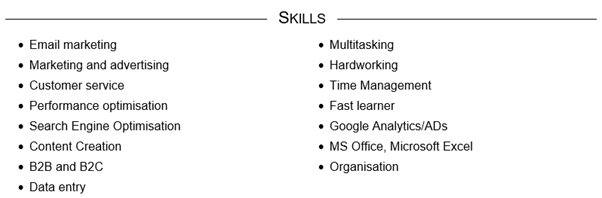
These are valid skills – but they are not aligned with Business Analysis roles.
This is what the Skills section looked like after being reworked to align with the industry they want to enter, instead of the industries they have been in to date:
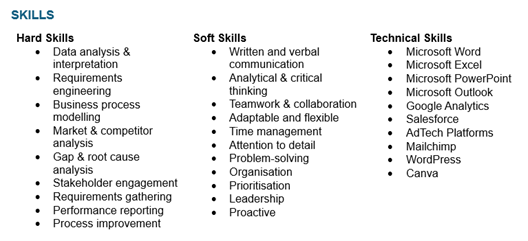
Now the CV signals immediate relevance – plus, it matches job descriptions, thereby passing ATS filters.
Moving on to our next example, our Data Analysis graduate does not have a Skills section on their original CV, but they have experience as a Barista and Marketing Assistant, with education that spans Marketing and Data Analysis.
In this case, we can rework their experience into the following skills:
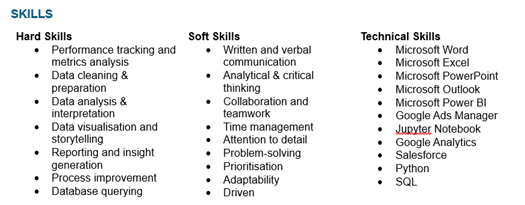
These skills position the candidate clearly within data analysis, supported by both CompTIA and BCS certifications.
The key principle is that your skills section should reflect what employers are searching for – not just what you’ve done. A good way to assess this is by thinking about what kinds of skills you see most often in the roles you are applying for, and whether you can confidently demonstrate that skill on your CV (and, more importantly, in an interview).
3. Education vs Certifications: A Critical Distinction
This is one of the most overlooked areas – and one of the most important.
The difference between “Education and Training” and “Certifications”.
Many candidates group everything together, but there is a clear difference:
Education and training show what you’ve completed. Certifications demonstrate validated competence through accredited assessment.
Your CV should clearly separate Education & Training (which includes study programmes, degrees, and online courses) and Certifications (which include certifications issued through official awarding bodies).
This structure ensures recruiters can immediately see your validated credentials, which are usually among the deciding factors in career-change hiring.
If you’re unsure where exactly something belongs on your CV, ask yourself:
1. Did I have to pass a formal, externally assessed exam to earn this?
- If yes, it’s likely a certification (e.g. PRINCE2, CompTIA, BCS, CIPD).
- If not, and you simply completed the course or completed a short quiz/test, it should go under Education and Training.
2. Is this recognised and awarded by an independent professional or accrediting body?
- Certifications are typically issued by organisations like PeopleCert, BCS, CompTIA, or CIPD, and are recognised across the industry.
- If it’s issued by a training provider without a formal external exam, it usually falls under Education and Training.
3. Does this qualification need to be renewed or kept up to date?
- Many certifications require renewal or continued professional development to remain valid.
- If there’s no renewal requirement, it’s more likely to be a course completion (Education and Training) rather than a certification.
If you’re still unsure, a simple rule is that certifications prove competence, whereas education shows learning.
Certifications should be highly visible and clearly separated – they are one of your strongest assets as a career changer.
4. Work Experience: The Transformation That Makes the Biggest Difference
Most candidates describe what they did on their CVs – but strong CVs show how that work is relevant.
To do this, we use a simple (but very effective) structure:
Action + (Scope) + Impact
For example, let’s look at our Business Analysis candidate again to understand their original Work Experience section:
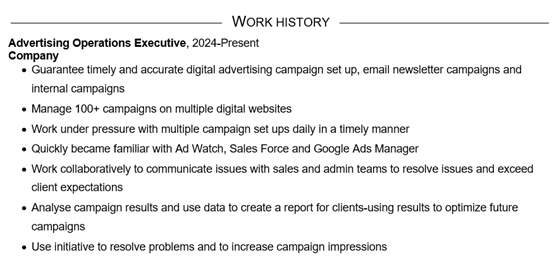
Some main points are:
- “Managed campaigns”
- “Worked with teams”
- “Analysed results”
Now, let’s see what the Work Experience looks like after it has been reworked to align with a Business Analyst role with the new Action + (Scope) + Impact formula:
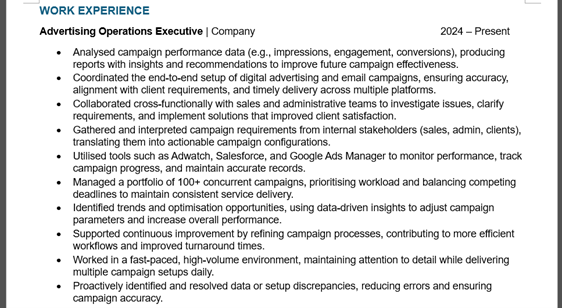
Now some key points are focusing on:
- Analysing campaign performance data to identify trends and improve outcomes,
- Collaborating with stakeholders to gather requirements and implement solutions, and
- Producing reports with insights to support decision-making.
These are much more aligned with the kinds of skills and experience that a Business Analyst would have and be responsible for.
Now, let’s take a look at a CV for a previous Data Analysis graduate. Their Work Experience section reads as follows:
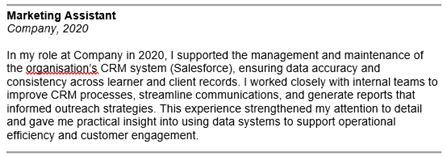
A simple statement, such as:
“Worked closely with internal teams to improve CRM processes…”
Becomes:
“Maintained and improved CRM data accuracy, supporting effective reporting and data-driven decision-making”
Now, let’s look at an IT graduate’s Work Experience, which comprises purely of non-technical formal experience:
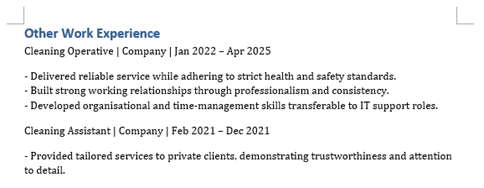
“Delivered reliable service while adhering to strict health and safety standards”
Is reframed as:
“Followed structured processes and documentation, demonstrating consistency and attention to detail”
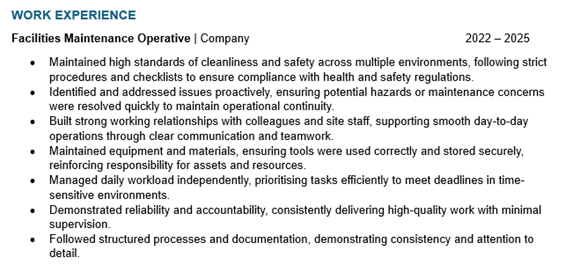
Let’s go through one more example for a highly experienced Project Manager looking to transition into Human Resources.
Their original Work Experience reads:

With a little bit of tweaking, this can be repositioned as:
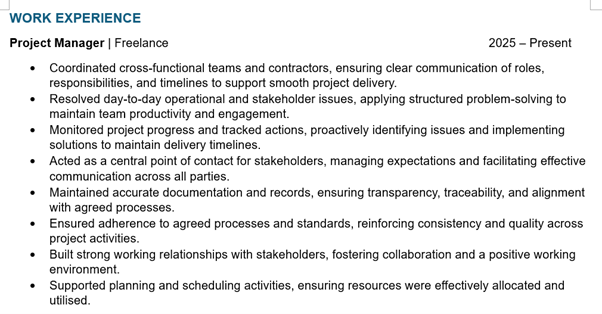
This reframes the experience to highlight stakeholder engagement, process adherence, documentation, compliance, and people-focused coordination.
All of which are highly relevant in HR roles.
Across all of these examples, the experience hasn’t changed – only how it’s been positioned.
Sections like hobbies, languages, or projects are optional – but they can certainly add value when used correctly.
Many IT candidates include lab work gained from their studies through ITOL Recruit or technical projects. Data Analysis candidates can reference personal analysis projects, and HR candidates may be inclined to highlight volunteering or people-focused work.
For example:
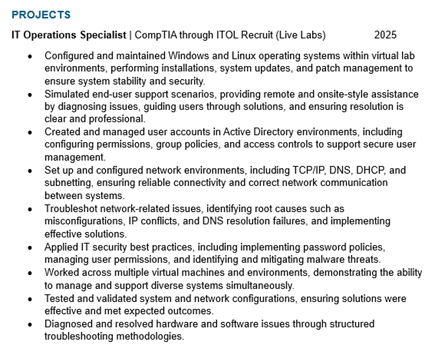
However, these should only be included if they strengthen your relevance, not fill space.
You Don’t Need to Start Over
Most career changers believe they need more experience.
In reality, they need better positioning.
Your existing experience already contains the skills employers are looking for. When structured correctly, supported by recognised certifications, and aligned with job requirements, it becomes exactly what hiring managers need to see.